

Therizinosaurus was a Large Maniraptoran Theropod with Huge Claws
With claws longer than a samurai sword and the potbellied build of a giant sloth, Therizinosaurus wasn’t just strange — it was a walking paradox. And despite the terrifying version seen in Jurassic World Dominion, the real creature was likely weirder… and far more peaceful.
Therizinosaurus was an advanced, herbivorous maniraptoran theropod — a mouthful that essentially means it was a close relative of raptors and birds, but with an herbivore’s diet. For years, scientists mistakenly believed it was some kind of bizarre sauropod, thanks to its odd mix of features. Its towering frame, strange proportions, and enormous claws made it one of the most unusual dinosaurs ever discovered.
The name Therizinosaurus (pronounced Ther-uh-ZEEN-oh-sawr-us) comes from Ancient Greek and means “scythe lizard” or “reaping lizard,” a nod to those iconic claws. Much of what we assume about Therizinosaurus is based on more complete fossils from its cousins — like Beipiaosaurus, which had protofeathers, and Nothronychus, which revealed detailed forelimb anatomy.
Therizinosaurus and its relatives evolved in a patchwork, with some features resembling primitive dinosaurs while others showed advanced traits — a rare evolutionary blend that continues to puzzle scientists. Once considered evolutionary outliers, Therizinosaurs are now recognized as a true branch of maniraptoran theropods — close relatives of raptors and birds.
Living about 70 million years ago in the Late Cretaceous, Therizinosaurus was not only one of the largest members of its group, but also one of the last. It lends its name to a whole branch of bizarre, pot-bellied, long-clawed dinosaurs: the therizinosaurs — formerly known as segnosaurs — and remains the most iconic among them.
Quick Facts
| Name | Therizinosaurus cheloniformis (“scythe lizard”) |
| Pronunciation | Ther-uh-ZEEN-oh-sawr-us |
| Prehistoric Era | Late Cretaceous (around 70 million years ago) |
| Classification | Herbivorous Maniraptoran Theropod |
| Order | Saurischia |
| Suborder | Theropoda (same group as raptors and modern birds) |
| Clade | Therizinosauria – known for bizarre, plant-eating theropods |
| Length | Up to 33 feet (10 meters) |
| Height | ~10 feet at the hips (3 meters) |
| Weight | Estimated 5.5 short tons (4.99 tonnes) |
| Top Speed | Estimated 17 mph (though likely much slower in practice) |
| Fossil Range | Nemegt Formation, Southern Mongolia |
| Habitat | Subtropical forests and semi-arid floodplains of ancient Asia |
| Known For | Longest claws of any known animal (over 3 feet long) |
| Skull Material | Not yet discovered – appearance inferred from relatives |
| Famous Relatives | Beipiaosaurus, Nothronychus, Falcarius (more complete fossils) |
A Walking Mismatch: What Did Therizinosaurus Actually Look Like?

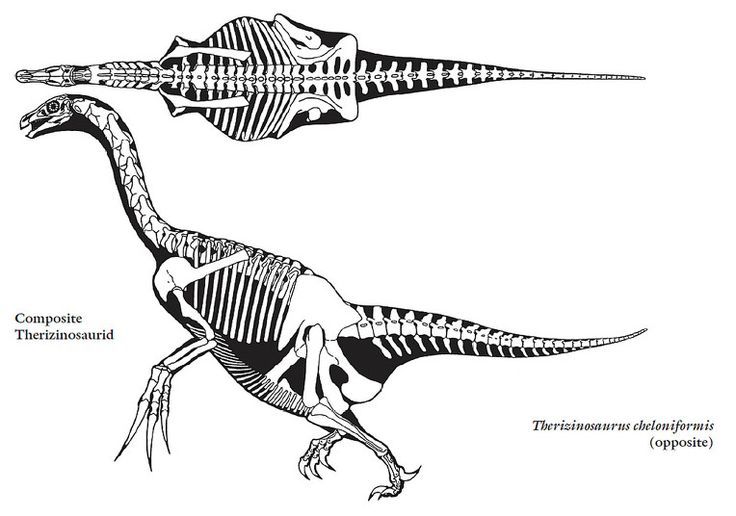
Paleontologists still don’t have a complete picture of what Therizinosaurus looked like, only partial fossils have been recovered, but by comparing it to other therizinosaurs, scientists have pieced together a likely profile.
It probably had a small head perched on a long, slender neck, with a beaked mouth suited for stripping vegetation. Its body was massive and bulky, with a pronounced pot belly and a short, stubby tail. Therizinosaurus stood upright on two thick, muscular hind legs, each ending in four bird-like toes designed to support its enormous weight.
Its arms were truly astonishing: over 8 feet long, ending in three fingers tipped with claws that could grow up to 3.3 feet, roughly the length of a human arm. These are the longest claws ever discovered in any known animal, and they were likely covered in a keratin sheath that made them even more fearsome in appearance.
Though no feathers have been found with Therizinosaurus fossils, its close relative Beipiaosaurus was discovered with protofeathers, early feather-like structures, leading scientists to believe Therizinosaurus may have been feathered too, possibly giving it a shaggy, birdlike appearance.
According to paleontologist Gregory Paul, a full-grown Therizinosaurus could reach 33 feet in length, nearly 10 feet in height at the hips, and weigh up to 5.5 tons, making it the largest known member of both the Therizinosauria and the broader Maniraptoran group, which includes birds and raptors.
Physical Attributes of Therizinosaurus – The Claws
The claws of Therizinosaurus are the longest ever found on any known animal and must have made an unforgettable impression in life. They were relatively straight, narrow, and flattened from side to side, gradually tapering to sharp points. While their exact purpose remains uncertain, many scientists believe the claws could have been used for defense against predators like the 39-foot-long Tarbosaurus, or in confrontations between males competing for mates or territory. Some even speculate that the size of the claws may have signaled reproductive maturity, with larger claws offering an advantage during mating season.
Despite their intimidating appearance, Therizinosaurus may have been more of a gentle giant. Some paleontologists compare it to a modern-day panda, using its claws primarily to help gather food. The claws might have been used to pull down leafy branches or strip bark from trees. Others suggest the claws could have helped it forage for fruit and leaves by climbing, much like a giant ground sloth, although Therizinosaurus was far too heavy to climb very high.
A Giant Clawed Herbivore: What Was on the Menu?
No skull or teeth from Therizinosaurus have been discovered so far, which makes its exact diet a mystery. However, based on its relatives within the Therizinosauria group, most paleontologists believe it was herbivorous.
There has been some speculation that Therizinosaurus might have used its massive claws to tear into giant termite mounds, suggesting it could have been an insectivore. But given its enormous size, it is unlikely that it could have survived on insects alone.
Other therizinosaurs had leaf-shaped teeth and beak-like mouths, which would have been well suited for eating plants. Many scientists believe these dinosaurs used their long arms and claws to pull down branches, strip leaves, or tear bark from trees, making Therizinosaurus a specialized forager rather than a predator.
How did Therizinosaurus Move?
Paleontologists believe Therizinosaurus was bipedal, walking upright on its two powerful hind legs. Its unusual body shape, especially the large pot belly more typical of four-legged dinosaurs like sauropods, has led some to wonder if it may have occasionally walked on all fours. However, this would have been difficult, if not impossible, due to its enormous forelimb claws.
It is unclear whether Therizinosaurus could run or how fast it could move. Most researchers agree it was likely a slow-moving animal, both because of its size and the impracticality of running with such long claws. Much like a person avoiding a sprint while holding scissors, Therizinosaurus would have risked serious injury from a single stumble.
Where did Therizinosaurus Live?
Around 70 million years ago, Therizinosaurus roamed the forests of what is now the Gobi Desert in southern Mongolia. During the Late Cretaceous, this region featured a mix of environments. While much of the area was dry and arid, with desert-like conditions, patches of forest offered warmer, wetter microclimates. These forested pockets likely provided the vegetation Therizinosaurus relied on, making it a rare herbivore in a landscape dominated by predators and harsh terrain.
The Discovery of Therizinosaurus

Fossils of Therizinosaurus are rare, which has made this dinosaur a puzzle for paleontologists since its discovery. Only a few parts of its skeleton have ever been found, including its massive hand claws, portions of the pelvis, and fragments of its forelimbs and hind limbs. With no skull or teeth uncovered, scientists have had to reconstruct its appearance and behavior by studying its close relatives within the Therizinosauria group and other similarly sized dinosaurs from the same era.
The first fossils were unearthed in 1948 during a Soviet-Mongolian expedition to the Nemegt Formation in the Gobi Desert. Among the discoveries were three enormous, sickle-shaped claws. Their size and shape resembled those of certain turtles, and because the claws were found alongside large flat bones, early researchers believed the creature was some kind of giant aquatic turtle. In 1954, Russian paleontologist Evgeny Maleev formally named the species Therizinosaurus cheloniformis, meaning “turtle-formed scythe lizard.”
It wasn’t until years later, after the discovery of a massive forearm initially attributed to another dinosaur (Deinocheirus), that researchers began to suspect Therizinosaurus was not a turtle at all, but a bizarre theropod — and one of the strangest ever identified.
Further discoveries in the 1990s of related dinosaurs like Alxasaurus and Beipiaosaurus helped clarify the group’s place in the dinosaur family tree. Once thought to be a savage predator, Therizinosaurus turned out to be something much more unusual — a slow-moving, plant-eating theropod with claws that looked built for battle, but likely served a more peaceful purpose.
Why Scientists Obsess Over This Prehistoric Weirdo
Therizinosaurus stands out as one of the most unusual dinosaurs ever discovered — a herbivorous maniraptoran theropod with claws unlike any other. Though paleontologists still debate the exact purpose of those massive claws, whether for foraging, defense, or display, their existence offers key insights into how strange and diverse dinosaur evolution could be.
Despite its fame, Therizinosaurus remains something of a mystery. With only partial fossils to study, many questions about its appearance and behavior remain unanswered. Scientists hope that future discoveries will uncover a more complete skeleton, helping to finally reveal the full story of this gentle giant and its place in the prehistoric world.
